




What Does Return on Investment Mean for Property?
Return on investment, or ROI, expresses a gain or loss as a percentage of the money invested. It can help you compare a purchase with its eventual outcome, but it does not predict profit. With property, the first question is what you are measuring: a sale profit, annual rental yield or the return on your own cash after borrowing. Those are different calculations.
What ROI Can Tell You
A useful percentage comes with a defined period, a clear cost base and an explanation of what is included:
A purchase decision: Estimates help test a price against expected income and costs. They remain assumptions until the income and expenses occur.
Performance: Actual results show what an investment earned or lost relative to its cost.
Planning: A cash-flow budget shows when money is needed, which a single return percentage cannot.
A target: There is no universal double-digit benchmark. A suitable target depends on risk, financing, currency and the holding period.
Comparison: Compare like with like: the same period, currency and treatment of debt, tax and transaction costs.
Risk: Run a lower-rent and higher-cost scenario. ROI does not, by itself, measure the probability of a loss.
The Formula and Worked Examples
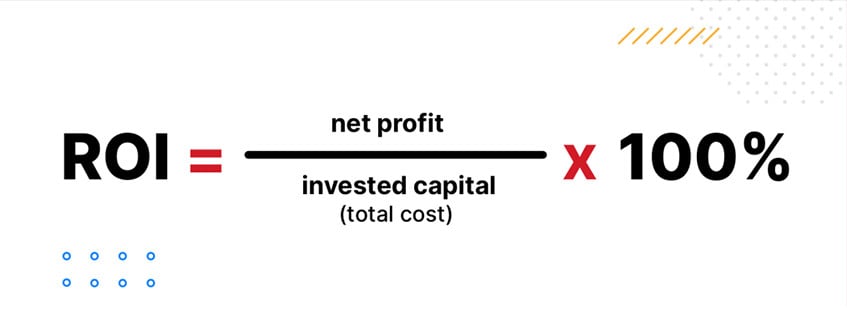
Start with an unlevered sale example. In this simple calculation, total investment cost includes the purchase and all costs assigned to the investment; net profit is the amount left after those costs:
ROI (%) = (Net profit / Total investment cost) × 100
If the all-in cost is USD 150,000 and net sale proceeds are USD 180,000, profit is USD 30,000 and ROI is 20%. That is the return over the holding period, not automatically an annual return. Additional costs would reduce it.
Rental property
For an annual net rental yield, divide annual rental income after the stated operating expenses by the defined acquisition cost. USD 10,000 of annual operating income on USD 150,000 of total acquisition cost gives about 6.67%, before financing and personal income tax. This excludes any change in value. Be explicit about vacancy, repairs, management and insurance; our guide to property taxes in Turkey covers another part of the cost picture.
Cash-on-cash return (%) = (Annual pre-tax cash flow after debt service / Cash invested) × 100
A financed purchase
Suppose a USD 500,000 purchase uses USD 180,000 of your cash and a USD 320,000 loan. If the value rises to USD 600,000 and the loan balance stays unchanged, equity is USD 280,000, not USD 420,000. Equity divided by property value is an equity ratio, not ROI. The USD 100,000 unrealised gain is about 55.56% of the initial cash, before interest, transaction costs, taxes and rental cash flow. It is not an annual cash return or a realised sale profit.
A cash purchase
Assume total acquisition and improvement cost of USD 150,000, annual rent of USD 18,000 and stated annual operating expenses of USD 5,000. Operating income is USD 13,000, giving an annual net rental yield of about 8.67%, before personal income tax and with no borrowing. Include realistic vacancies and future replacement allowances in a fuller budget.
Other Measures You Will Encounter
Sale profit: Deduct acquisition, improvement, holding and disposal costs as applicable from the proceeds and income. Define the period and avoid counting the same expense twice.
Cash-on-cash return: Divide annual pre-tax cash flow after operating costs and debt service by the owner’s cash invested. For example, USD 12,000 on USD 180,000 is about 6.67%. It measures current cash income, excluding unrealised appreciation.
Net operating income (NOI): Property income less vacancy and operating expenses, before debt service and the owner’s income tax. Capital expenditure and depreciation are treated separately.
Capitalisation rate: Annual NOI divided by purchase price or current property value. State which value you use. It excludes financing and is not a complete total-return measure.
Appreciation: An increase in value is a paper gain until realised. Values can also fall; a valuation does not itself pay the bills.
Internal rate of return (IRR): This accounts for the timing of cash flows by finding the discount rate that makes their net present value zero. Results depend on the assumed payments and exit proceeds.
What Changes the Result?
The calculation changes with the property, its use and the period of ownership:
Location
Access to work, transport and services affects the likely users. A desirable address may also cost more, so demand alone does not establish a higher percentage return.
Condition and maintenance
A well-kept home may need less immediate work, but the price can reflect that advantage. Include recurring upkeep and major replacements, not just initial repairs.
Rent and expenses
Use achievable rent, realistic occupancy and the full cost of lawful letting. Higher advertised rent does not necessarily mean more money retained.
Market conditions
Purchase prices, borrowing rates, rents and resale demand can change. Use consistent currency assumptions and consider inflation when judging purchasing power.
Common Calculation Mistakes
Most misleading results come from inconsistent inputs rather than difficult mathematics:
Assuming the best outcome: Peak rent and a quick resale should not be the only scenario.
Leaving out expenses: Include transaction costs, vacancy, insurance, management, repairs and relevant taxes. Show what is excluded.
Using weak comparisons: Asking prices and promised rents are not completed sales or collected income. Keep evidence current and comparable.
Skipping the right advice: Use an agent for market information and suitable legal, tax and technical advisers for matters requiring their expertise.

Ways to Improve the Investment Plan
Improvement starts with the purchase price and a workable operating plan. None of the following guarantees a return:
Buy with a repair budget: Compare condition with price. A cheaper home needing work is not automatically worse, and a finished home is not automatically better value.
Test the rent: Look for comparable lettings and allow for the months when the home may be empty.
Choose for the occupant: A location should fit the likely resident or guest, rather than a broad claim that the district is popular.
Spread exposure thoughtfully: Different properties can still share currency, tourism and financing risks.
Plan a longer hold: Keeping a property can spread transaction costs over time, but ongoing expenses and market risk remain.
Examine developing areas carefully: Future infrastructure and demand are assumptions until delivered. Budget for delays and a slower resale.
Discuss a Property Purchase in Turkey
TERRA Real Estate ® is a licensed real estate company operating since 2004, holding the Official Authorization Certificate for Real Estate Transactions issued and supervised by the Turkish Ministry of Commerce. When comparing property in Turkey, tell us your budget and intended use. We can help you find relevant homes and gather the property information needed for a realistic assessment, alongside your legal and financial advisers.
Call us on +90 242 512 25 00, use WhatsApp on +90 532 341 67 54 (@terrarealestate), or send us a message. If you are already in the area, we can arrange free, no-obligation viewings and pick you up by appointment.